
Clasp Adaptation — Without Sending the Partial Denture to the Lab
When a patient can't part with their partial, you can still adapt a new crown to the existing clasp and rest. A chairside indexing technique using a heavy-bodied PVS or polyether.
Removables Center of Excellence
Partial & Full Denture Specialists
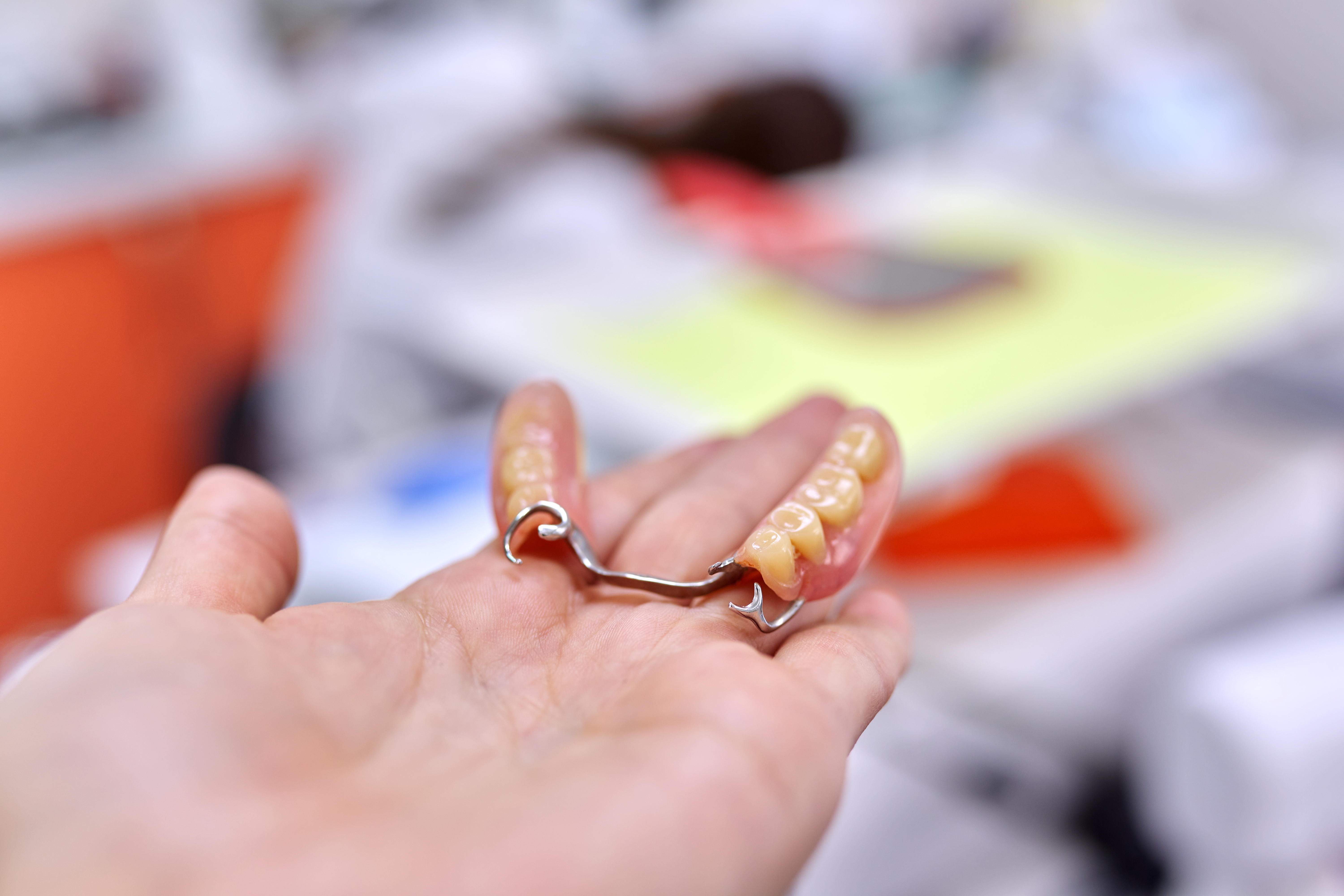
If you find yourself in a situation where a patient cannot be without their partial denture, but you need to adapt the clasp and rest to a new crown you'll be fabricating — there is a way for the lab to adapt the restoration to the clasp and rest without having the actual partial denture on hand.
How It's Done
Here is a technique performed successfully many times for indexing partial denture rests and clasps to the underlying preparation, using Ramitec® (or any heavy-bodied, highly viscous PVS or polyether). This procedure is performed in the mouth. The stone models shown in case photos are for demonstration only.
- Pre-polish to a high-shine, mirror finish on the underside of the clasps and rest, being sure to remove all plaque and debris.
- Provide a pre-op study case.
- Prep the tooth, pack cord, and take an impression.
- Mix a small amount of Ramitec — about the size of a piece of chewing gum. Place it over the preparation, covering the entire prep, the margins, and just touching the contacting proximal teeth.
- Seat the partial clasp and rest onto the Ramitec, capturing a very clear impression of the cleaned and polished underside of the clasp and rests (the surfaces contacting the tooth).
- Be careful not to bury the clasps or rests, or incorporate any creases, streaks, voids, or bubbles. Allow the material to set completely before removal.
This index, along with the pre-op cast, enables the technician to make an acrylic reproduction of the clasps and rests in relation to the prep and proximal teeth.
Keep reading
Related from the journal
 Clinical Technique
Lab Tips for Anterior Cases Involving Two or More Teeth
Multi-unit anterior work rewards preparation. From pre-op records and bite registration to impressioning, shade, photography, draw, and implant componentry — a field guide for predictable results.
Read article Clinical Technique
Full Mouth Rehabilitation Treatment Plan
A carefully planned workflow — in the clinic and the lab — is what makes full-mouth rehabilitation predictable. From clarifying goals and facebow transfer to the diagnostic wax-up and prep-day bite sequencing.
Read article Esthetics
Shade Accuracy Guidelines for Restoration
A few must-follow guidelines make a world of difference in a patient's smile. From bleaching timelines to hydration and reflected light, here's how to capture a shade that looks completely natural.
Read article